Example dataset: Biomphalaria glabrata (PRJNA1306560)
The example figures shown throughout the MTD Explorer documentation were generated from publicly available RNA-seq data deposited in the NCBI Sequence Read Archive under BioProject PRJNA1306560.
Using a single public dataset across the documentation makes the examples traceable and reproducible while demonstrating host transcriptomic, microbiome, functional, exploratory, and host–microbiome integration analyses within the same biological system.
Dataset overview
Organism: Biomphalaria glabrata
NCBI Taxonomy ID: 6526
BioProject: PRJNA1306560
SRA Study: SRP609141
BioSample: SAMN50639599
Submitting institution: Queen's University Belfast
Sequencing strategy: RNA-Seq
Library source: Transcriptomic
Library layout: Paired-end
Sequencing platform: Illumina NextSeq 2000
Number of SRA runs: 15
Public release: 15 August 2025
Biological context
Biomphalaria glabrata is a freshwater gastropod mollusc and an important intermediate host of Schistosoma mansoni, the parasitic trematode responsible for intestinal schistosomiasis.
The B. glabrata–S. mansoni interaction is a widely studied host–parasite system. Following parasite exposure, compatible snails can support intramolluscan parasite development and ultimately release cercariae capable of infecting a vertebrate host. Infection outcome can therefore provide a useful biological framework for investigating host responses and host-associated microbial communities.
Because genomic and transcriptomic resources are available for B. glabrata, this system is also well suited to the joint host-transcriptome and microbiome analyses performed by MTD Explorer.
Host–parasite system
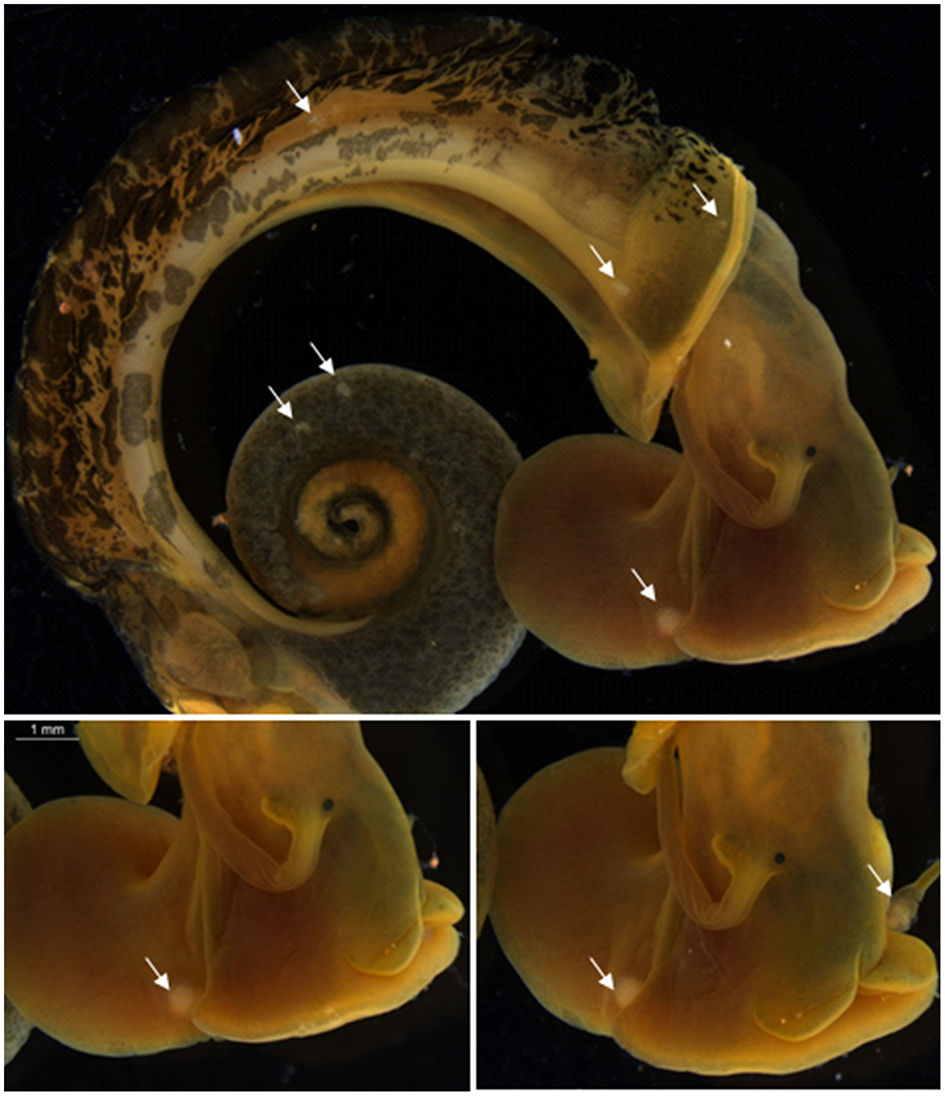
Dissected snail showing primary sporocysts of Schistosoma mansoni (arrows); scale bar = 1 mm.
Source: Lima et al. (2019), Frontiers in Immunology 10:328 . CC BY 4.0 .
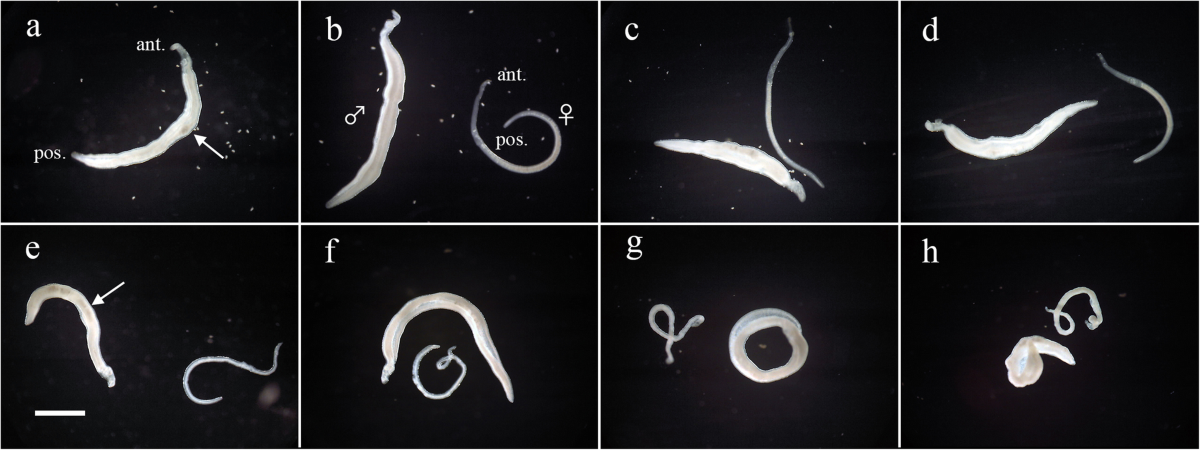
Paired adult worms shown by light microscopy; scale bar = 1 mm.
Source: Mitsui, Miura & Kato (2020), Tropical Medicine and Health 48:42 . CC BY 4.0 .
These images provide independent biological context for the B. glabrata-S. mansoni system and are not images from BioProject PRJNA1306560.
Experimental structure
The public dataset contains 15 paired-end RNA-seq runs, divided equally among three deposited library groups:
| Group | Number of runs | Library names |
|---|---|---|
infected |
5 | infected_1 – infected_5 |
infection_failed |
5 | infection_failed_1 – infection_failed_5 |
uninfected |
5 | uninfected_1 – uninfected_5 |
| Total | 15 |
The SRA accessions span:
Sample metadata
All 15 runs are associated in the deposited SRA metadata with the BioSample
SAMN50639599, whose sample name is Snail_rna_seq.
The experimental identities used by MTD Explorer are therefore derived from the deposited library names:
MTD Explorer preserves these labels rather than attempting to reinterpret the experimental classifications assigned by the data submitters.
About the infection_failed label
The public SRA metadata use infection_failed as one of the library-group
labels. The deposited RunInfo metadata do not define the exact biological
criterion used to assign this outcome.
For this reason, the MTD Explorer documentation retains the original label without interpreting it as a specific mechanism such as resistance or susceptibility.
How the dataset is used in this documentation
The complete MTD Explorer run contains all three experimental groups.
For concise examples of pairwise differential analysis, the documentation primarily displays:
Other analyses use the complete three-group dataset where appropriate.
The dataset is used to illustrate outputs from:
- host gene-expression analysis;
- microbiome taxonomic profiling;
- differential microbiome analysis;
- functional profiling;
- ssGSEA;
- HAllA host–microbiome integration;
- taxonomic exploratory analysis;
- alpha and beta diversity;
- core microbiome analysis;
- taxonomic composition and abundance;
- microbiome quality-control summaries.
The example figures therefore provide a consistent view of the different MTD Explorer result layers using one public RNA-seq dataset.
Publication status
The SRA RunInfo metadata for PRJNA1306560 / SRP609141 do not report an associated PubMed identifier.
At the time this page was prepared, no peer-reviewed publication could be unambiguously linked to PRJNA1306560 through the accession itself.
A 2025 doctoral thesis from Queen's University Belfast, From taxa to transcripts: investigating the snail holobiont in the context of helminth infection, investigates the Biomphalaria glabrata– Schistosoma mansoni system, the snail-associated microbiome, and multi-omic approaches including transcriptomics.
However, the publicly available thesis record does not explicitly identify PRJNA1306560. It is therefore presented here only as related scientific context, not as a confirmed publication associated with this BioProject.
Interpretation of the documentation figures
Example outputs, not original study results
Figures displayed in the MTD Explorer documentation were generated by MTD Explorer from the public sequencing data.
They are intended to demonstrate pipeline behavior, analysis modules, output organization, and visualization types.
Unless independently supported by the original study metadata or a linked publication, these figures should not be interpreted as reproducing the original investigators' statistical analyses or biological conclusions.
Reproducibility
Users wishing to reproduce these examples should retrieve the original sequencing reads together with the associated SRA metadata so that public accession numbers and deposited experimental labels remain traceable.
The principal public identifiers are:
| Resource | Accession |
|---|---|
| NCBI BioProject | PRJNA1306560 |
| SRA Study | SRP609141 |
| BioSample | SAMN50639599 |
| NCBI Taxonomy | 6526 |
| SRA runs | SRR35002006–SRR35002020 |